Prehistory
Portugal has a wealth of prehistoric archaeological finds. The Upper
Alentejo was a focal point for the megalithic culture which extended
throughout several areas of the Iberian Peninsula. A number of dolmens
and menhirs are still standing in various locations throughout the
country, in addition to a large cromlech near Évora, the Cromeleque dos
Almendres (photo).
To see Évora's tours, click here.
The Romans
Remains from the civilisation
created by Romans, the master builders, include bridges, theatres, spas
and villas, which are dotted throughout the country. The temple
dedicated to the cult of the Emperor in Évora is one example of a
well-preserved Roman temple. It has Corinthian columns supported by a
base that stands several metres high. The most interesting group can be
found at Conímbriga (photo), where many structures have survived, including a
building that may have served as an inn, an aqueduct and two thermal
baths. The House of the Fountains is particularly interesting, with its
water feature (there are over 400 jets of water), lined by brick
columns and surrounded by exceptionally well-preserved tiles. The
mosaics depict mythological or hunting scenes or geometric designs.
To see Évora's tours, click here.
To see Conímbriga's tours, click here.
The Visigoths
Some churches still display the
remains of the work of these Christian peoples who inhabited the
Peninsula between the period of the Roman Empire and the Arab
Invasions.
Islamic architecture
Certain machines designed
to draw water from wells, such as the waterwheel or picota (shaduf),
can still be seen in the Portuguese countryside, particularly in the
south. Echoes of Islamic art and architecture remained in Portuguese
art for many centuries. The Manueline style incorporated certain
Islamic-style designs and 19th. century Romanticism revealed a taste
for the Neo-Arab (in addition to other revivals).
Romanesque architecture
From the 12th. century
onwards, Portugal was an independent nation and its architecture became
Romanesque. Churches, chapels and cathedrals were usually built from
solid granite in the north of Portugal, giving them an austere, and
often military, appearance. Decorative features were concentrated
around doorways, rose windows and archivolts, where the stone was
carved with great skill.
Gothic architecture
Churches became much more
majestic, with ribbed vaults to support the roof. Ogival structures
predominated, in an attempt to reach the heavens. The Batalha Monastery (photo)
is a masterpiece dating from this era, in addition to the medieval
castles with their imposing and skilfully constructed keeps.
To see Batalha's tours, click here.
The Manueline period
W
orks dating from the
Manueline period represent the most original expression of Portuguese
architecture. Churches and other buildings began to acquire more
elaborate decorative features within a space that was more static (and
more Renaissance in style) but still revealed many features that were
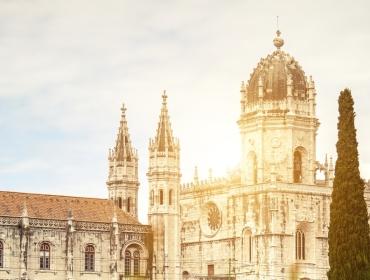
typical of the late Gothic period. The Castle and Convent of the
Templars in Tomar and the Jerónimos Monastery and Belém Tower (photo) in Lisbon
are masterpieces of this uniquely Portuguese style of architecture.
To see Tomar's tours, click here.
To see Lisbon's tours, click here.
The Renaissance
The influence of Italian and
Roman art was particularly strong in Portugal up to (and including) the
Baroque period. Religious and civic buildings and cloisters featuring a
strictly classical style and geometric balance began to appear.
Facades, with their interplay of windows, pilasters and pediments,
displayed an impressive formal unity. The University of Évora (photo) is a good
example of this style.
To see Évora's tours, click here.
Baroque
T
he Baroque era of the 18th. century is
the second most glorious period in Portuguese art. During this time a
spectacular number of religious and civic buildings were constructed.
The interiors of churches were filled with carved gilt work and both
the interiors and exteriors of buildings were lavishly decorated with
Baroque sculptures. The iconic king of this age was João V and Mafra (photo)
was his greatest work.
To see Mafra's tours, click here.
Romanticism
With the Romantic movement of the
19th. century came revivalism and eclecticism. A taste for Medieval,
Arab and Manueline styles emerged in an excess of fantasy. Sintra is
the Romantic site par excellence in Portugal, home to Quinta da
Regaleira, a scenic and esoteric construction built on the slopes of a
hill with its many tunnels, labyrinths and entrances decorated with
mythological motifs, and also to the Pena National Palace (photo), built by a
King Consort on the top of a mountain to match his poet’s dreams,
displaying many architectural designs and caprices.
To see Sintra's tour, click here.
Iron architecture
I
n the 19th. century,
parallel to Romanticism, the industrialisation of the country began and
iron lattice structures started to appear. The Santa Justa elevator in
the Lisbon baixa area and the D. Luís bridge (photo) in Porto date from this
period, the latter being one of the most beautiful iron bridges in
Europe.
To see Lisbon's tours, click here.
To see Porto's tours, click here.
20th. century
The beginning of the 20th.
century was marked by the expansion of Lisbon. Trends such as Art
Nouveau and Arte Deco (developed by Cassiano Branco) were introduced
into the urban vocabulary of the city. Later, Modernism entered in
force with architects such as Pardal Monteiro, who designed many
buildings for the capital.
At the same time, architects such as Raul Lino attempted to blend
traditional designs with rational and modern ideas.
The Monument to the Discoveries in Belém (photo), created by Cotinelli Telmo
for the 1940 Exhibition of the Portuguese World, features in pure,
modernist style the figures of navigators boarding a ship. It has
become one more symbol of the city of Lisbon.
Too see Lisbon's tours, click here.
Present day
Nowa
days the most famous architect in Portugal is Álvaro Siza Vieira
from Porto, who uses characteristic smooth or curved white surfaces.
The Pavilhão de Portugal, in the eastern zone of Lisbon and the
University of Aveiro are two daring works by this architect. In
addition, the eastern area of Lisbon served as a laboratory for
cutting-edge experiments in architecture and urban planning at the end
of the 20th. century and as a case study for international
architecture.
To see Lisbon's tours, click here.
To see Aveiro's tours, click here.