This was the largest medieval church in Lisbon. It had three naves in an imposing, flamboyant Gothic style. During the 1755 earthquake its roof fell in and the arches remained as if poignantly reaching for the heavens. Today it is a large cathedral with the skies for a roof, with all the Romantic charm of solemn ruins. (Largo do Carmo. 10 am – 6 pm. Closed on Sundays)
This is a magnificent building from the early 18th century, Baroque yet with Roman-inspired elements, and the interior is decorated with inlaid marble. The building is quite colossal and very visible not only due to its sheer size but by the style of its dome, which may remind one of the Vatican. Its floor plan follows a centred, Greek cross structure, with rounded tops, on top of a square, from which four towers extend up, slightly marked by a concave curve in the façade. The Pantheon is the place where many legends, presidents and writers are buried, including the Fado singer Amália Rodrigues. (Campo de Santa Clara. 10 am – 5 pm. Closed on Mondays. € 2,50. Free admittance until 2 pm, every Sunday and bank holiday)
This building found in a corner of a downtown central block was an old, luxurious private residence of the capital. It was built after the 1755 earthquake and it gives the Praça de Restauradores plenty of personality. It has a very beautiful and very visible Neoclassical façade. On one of its sides, a narrow street leads you to the Glória Elevator, which will carry you ever so slowly up the steep hill in direction of Bairro Alto. (Praça dos Restauradores)
This is a very large plaza, and one of its outstanding traits is the fact that one of its sides is exposed towards the river, creating a U shape. The plaza follows a very strict formula. The other three sides are occupied by uniform façades, whose ends towards the river are two beautiful towers with large windows. The opposite side has an outstanding triumphant arch in an astonishing, Romantic style in contrast to the rational order of the plaza.
In the centre of the plaza, you’ll find the king José I riding statue in bronze. In the same axis, but after the arch, you have the Rua Augusta, a very important pedestrian and commercial street of the Baixa (“Downtown”), connecting the Praça de Comércio and the Rossio.
While the sea embraces the river, the river is teeming with fat-bellied boats that cross it, and with the shadows of the hovering gulls. To travel by boat to the other side of the river and then back is a very pleasant thing to do, because this plaza was made to welcome people to Lisbon from the river. Lisbon itself is a city to be seen from the river.
To the north stands the National Theatre, with its Neoclassical columns and façade. It encloses the plaza in a unique way.
Around the plaza there are many terrace cafés, and a curious little fountainhead at the centre. Pigeons fly all around you. The plaza is covered in the typical Portuguese cobblestone work, with blue waves against a white background, reminding us all that this was made by a country of sailors.
The train line connecting Lisbon to Sintra starts here. But no one would say it was a train station, as it looks more like a Venetian palace.
It was built in the 19th century, in Neo-Manueline style, which is an example of Portuguese Romantic architecture, consisting of a fantasy-tinted recreation of the Renaissance Manueline style from the time of Discoveries. It has an iron ceiling as expected, but outside only a discrete, small clock reminds us that we do have time to see more of the city.
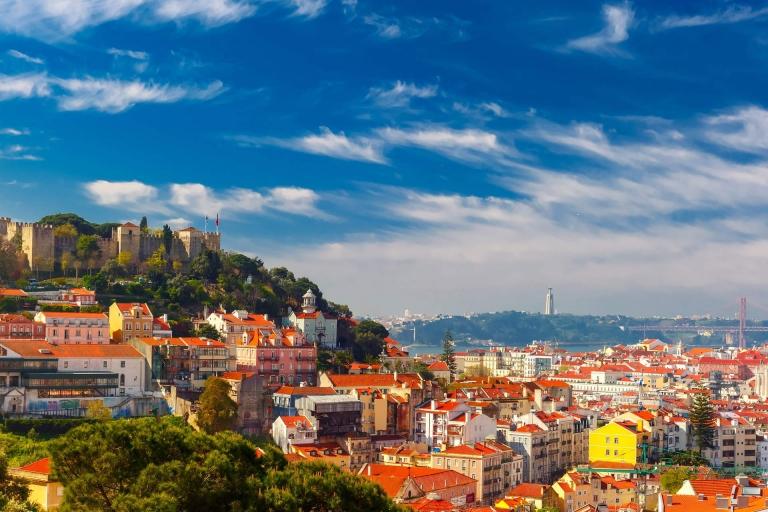
The Castle is on top of one of the seven hills of Lisbon, strategically hovering above the city and all its surroundings. From here you can see a considerable portion of the city, with its red tile roofs and a cascade of small houses all the way down the hills. This particular hill was always used as a defence point: the Iberian Celts used it to build the “castros” (fortifications), later on the Romans and then the Arabs built their own walls on top of the previous ones. The present Castle was built by king João I in the 14th century. It is quite large and the exterior curtain walls are topped by bulky square towers. The central area completes the medieval fortress, whereas a second perimeter today blends into the city.
There are many Mediterranean trees within the structure, from cypresses to pine trees, creating a soothing and pleasant environment. (Winter: 9 am – 6 pm; Summer: 9 am – 9 pm. €5; free admission for children under 10 and senior citizens).
This church has the austere, simple façade of all Jesuit churches. The interior, however, is highly contrasting, with all its gold-leafed wooden sculptures, its paintings and tile murals, coloured marbles, in luxurious Mannerist and Baroque decorations. It also houses the São Roque Museum, a treasure trove of liturgical vestments, goldwork, ancient painting and unique books, stemming from the 16th to the 18th centuries. (Largo Trindade Coelho. Mondays: 2 pm – 6 pm; Thursdays: 9 am – 8 pm; rest of the week, including weekend days: 9 am – 6 pm. Closed all non-religious holidays).
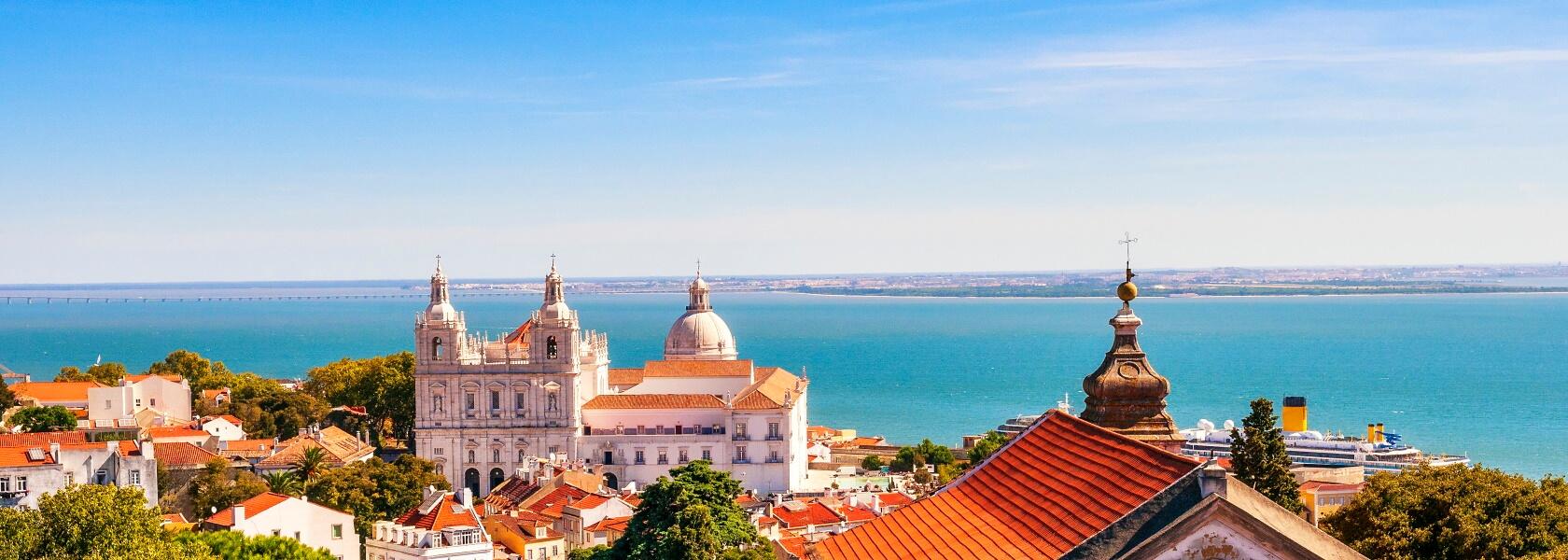
The church was built in 1582 by Filipe II, then king of Spain and Portugal. There is a monastery built next to it, following the Mannerist architectural style which is very balanced with clear and simple lines, with an imposing façade and two belfries on either side. The façade has three round arches with sculptures in alcoves. It is a great example of the great Catholic art of the Roman Counter-Reform. (Largo de São Vicente. Weekdays: 9 am – 4 pm; Saturdays: 9 am – 6 pm; Sundays: 9 am- 1 pm, free admittance)
It contains several medieval tombs, one of which is titled enigmatically “the tomb of the Unknown Princess”. The sacristy holds the relics of Saint Vicente. It also has a spectacular Baroque organ from the 18th century. (218 876 628. Largo da Sé. 9 am – 7 pm. Cloister: 9 am – 6 pm; €3).
The Lisbon town hall is in a medium-sized plaza, in which one finds a pillory. Its façade is in a Neoclassical style, with a delicate sculpture composition representing Freedom and Love for the Homeland. The building was constructed in the second half of the 19th century, and it houses the city’s government.